

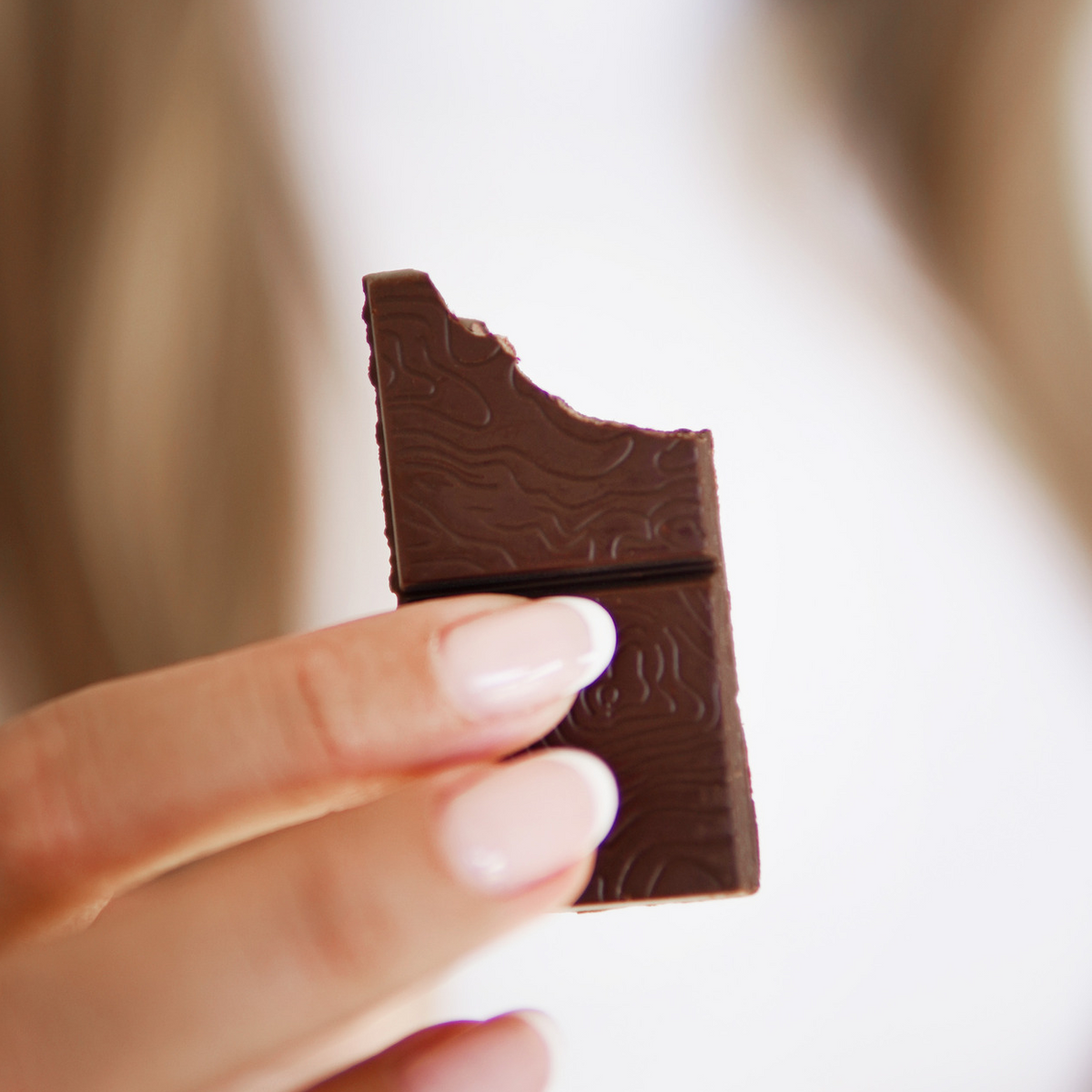
You’re standing in front of the chocolate aisle and see 55%, 70%, 75%, 85% printed across different bars.
Higher must mean better, right?
Not necessarily.
The percentage of cacao in chocolate tells you something very specific: how much of that chocolate comes from cacao ingredients. But it doesn’t tell you everything about the chocolate, how it tastes or what else is inside it.
A chocolate bar with a high cacao percentage can still contain added sugar and other ingredients. Meanwhile, two bars with exactly the same cacao percentage can have completely different ingredient lists.
So, if you’ve ever wondered what the percentage of cacao in chocolate actually means, let’s break it down.
What does cacao percentage mean?
Put simply, the cacao percentage on a chocolate bar tells you approximately how much of the product comes from cacao-derived ingredients.
Those cacao ingredients can include cacao mass — also called cocoa mass or cocoa liquor — and cacao butter.
For example, if a dark chocolate bar says 75% cacao, roughly 75% of the bar is made up of cacao ingredients. The remaining part of the recipe is made up of the other ingredients used to create that particular chocolate.
That distinction is important because cacao percentage doesn't simply mean “75% cacao powder”. Chocolate is made using different components of the cacao bean.
What counts towards the cacao percentage?
To understand the number on the front of the bar, it helps to understand what comes from the cacao bean.
Two of the main cacao ingredients used in chocolate are:
- Cacao mass: made by grinding processed cacao beans into a paste. It naturally contains both cacao solids and cacao butter.
- Cacao butter: the naturally occurring fat obtained from cacao beans.
Both can contribute towards the total cacao content of a chocolate bar.
This is why the percentage alone doesn't tell you the exact ratio of cacao mass to cacao butter in a particular recipe.
And that ratio matters when creating chocolate because cacao butter contributes to characteristics such as texture and melt, while the other cacao components contribute significantly to the characteristic cacao flavour.
If you want to learn more about what goes into our chocolate, you can explore our ingredients and why we use them here.
So, what does 70% dark chocolate mean?
If you see a bar labelled 70% cacao, it means approximately 70% of the chocolate comes from cacao ingredients.
The remaining 30% consists of the other ingredients in that particular recipe.
But here's the important part:
That 70% doesn't tell you what makes up the other 30%.
To know that, you need to turn the bar around and read the ingredients.
One 70% chocolate could use sugar in the remaining portion. Another could use a different sweetening ingredient. Recipes may also contain ingredients added for flavour, texture or other functional purposes.
The same principle applies whether the chocolate says 60%, 75%, 80% or 90% cacao.
Our Funky Fat Dark Chocolate, for example, contains at least 75% dry cocoa solids and is made without added sugar.

Does a higher cacao percentage mean better chocolate?
No. A higher cacao percentage simply means that a greater proportion of the chocolate comes from cacao ingredients.
It doesn't automatically tell you the quality of those cacao ingredients, the complete recipe or whether you will prefer the taste.
Cacao itself can vary considerably. Where the beans are grown, the cacao variety, fermentation, drying, roasting and chocolate-making process can all contribute to the final flavour. Chocolate production also involves steps such as refining and conching, which help create the texture and flavour of the finished chocolate.
So an 85% chocolate isn't automatically “better” than a 75% chocolate.
It is simply a different chocolate.
What matters is what you are looking for: the flavour, texture, cacao intensity and ingredients that suit you.
Does a higher cacao percentage mean less sugar?
Not necessarily.
A higher cacao percentage leaves less room for the other ingredients in the recipe, but the number on the front still doesn't tell you exactly what those remaining ingredients are.
If you specifically want to know whether a chocolate contains added sugar, the cacao percentage isn't where you should look.
Read the ingredient list.
“No added sugar” is a separate nutrition claim. In the EU, it has specific conditions governing when it can be used. It isn't determined by whether a chocolate contains 50%, 75% or 90% cacao.
In other words:
High cacao percentage ≠ automatically no added sugar.
If you want to get better at reading what is actually inside packaged foods, our guide on how to read food labels goes into this in more detail.
Does a high cacao percentage mean the chocolate has simple ingredients?
Again, not necessarily.
The cacao percentage tells you the proportion of cacao ingredients. It doesn't tell you how long or short the ingredient list is.
You could pick up two 75% dark chocolate bars and find completely different recipes on the back.
That's why we don't think the big percentage on the front should be the only thing you look at.
If the ingredients matter to you, read the ingredients too.
Does cacao percentage tell you whether chocolate contains additives?
No.
A cacao percentage doesn't tell you whether other ingredients have been added to the recipe.
Chocolate makers can formulate chocolate differently depending on the flavour, texture and characteristics they want to create. The percentage of cacao and the ingredient list therefore answer two different questions:
- Cacao percentage: How much of this chocolate comes from cacao ingredients?
- Ingredient list: What is this chocolate actually made with?
For us, the second question matters just as much as the first.
Why can two 75% chocolates taste completely different?
This is where chocolate gets interesting.
If two bars both contain 75% cacao, you might expect them to taste almost identical. But cacao percentage is only one part of the recipe.
The flavour can also be influenced by factors such as:
- The origin and variety of the cacao beans
- How the beans were fermented and dried
- How the cacao was roasted
- The balance between cacao mass and cacao butter
- The other ingredients used in the recipe
- How the chocolate was refined and conched
Even cacao itself can have different flavour characteristics depending on where it comes from and how it has been handled.
So if you've ever loved one 75% chocolate and disliked another, your taste buds aren't confused. The percentage was never the whole story.
Is higher-percentage chocolate always more bitter?
Higher cacao percentages often create a more cacao-forward flavour because a larger proportion of the recipe comes from cacao ingredients.
But percentage alone doesn't completely predict how bitter or intense a chocolate will taste.
The cacao itself, the way it has been processed and roasted, the balance of ingredients and the overall recipe all influence the final flavour.
This is also why choosing dark chocolate purely by chasing the highest number isn't necessarily the best way to find your favourite.
You might prefer 75%. Someone else might love 90%.
Chocolate is still supposed to taste good.

What percentage of cacao should I choose?
There isn't one perfect cacao percentage.
If you enjoy a stronger, more cacao-forward flavour, you may naturally gravitate towards higher percentages. If you prefer something smoother or milder, you may prefer a different balance.
Instead of asking only “Which chocolate has the highest percentage?”, try asking:
- What cacao percentage do I actually enjoy?
- What ingredients are used?
- Is there added sugar?
- What is used to sweeten the chocolate?
- What does the ingredient list look like?
- Most importantly: do I actually like the taste?
Because the highest number on the shelf isn't automatically the chocolate that's right for you.
Not sure which style you prefer yet? Our Variety Pack lets you try our different chocolate flavours and find your favourite.
How to read a chocolate label properly
Next time you're choosing chocolate, don't stop at the big percentage printed on the front.
Use this simple three-step check:
1. Check the cacao percentage
This tells you how much of the chocolate comes from cacao ingredients and gives you an idea of the style of chocolate you're looking at.
2. Turn it around
Read the ingredient list. This tells you what the cacao percentage can't.
Look at what has been used alongside the cacao ingredients and what has been used to sweeten the chocolate.
3. Choose based on the whole chocolate
Percentage. Ingredients. Flavour. Texture.
They all matter.
A cacao percentage is useful information — it just shouldn't be the only information you use.
What about Funky Fat Chocolate?
At Funky Fat Foods, cacao percentage is only one part of how we think about chocolate.
Our chocolate is made with carefully selected ingredients, including cacao mass and cacao butter, and is made without added sugar. Instead, we use erythritol to create sweetness without adding sugar to the recipe.
We also use ingredients such as MCT oil powder from coconut and chicory root fibre as part of our chocolate recipes.
You can see exactly what goes into each flavour on our ingredients and nutritional values page.
For us, it isn't about putting the highest possible cacao percentage on the front of the pack.
It's about the whole recipe: cacao, carefully selected ingredients, no added sugar and, very importantly, chocolate that we actually want to eat.
If you'd like to try it for yourself, explore our full chocolate collection, including our 75% Dark Chocolate, Dark Chocolate with Hazelnut, Dark Chocolate with Coconut, Milk Chocolate and White Chocolate with Bourbon Vanilla.
The bottom line: cacao percentage is only part of the story
So, what does the percentage of cacao in chocolate mean?
It tells you how much of the chocolate comes from cacao ingredients, including cacao mass and cacao butter.
That's useful information. But it doesn't tell you everything.
A higher cacao percentage does not automatically mean:
- The chocolate has no added sugar
- The chocolate has fewer ingredients
- The chocolate is free from additives
- The cacao itself is higher quality
- You'll prefer the flavour
So next time you see a big 70%, 75% or 85% printed on a chocolate bar, use it as the beginning of the story — not the end.
Turn the bar around. Read the ingredients. Then choose the chocolate that ticks the boxes that matter to you.

Leave a comment
All comments are moderated before being published.
This site is protected by hCaptcha and the hCaptcha Privacy Policy and Terms of Service apply.